
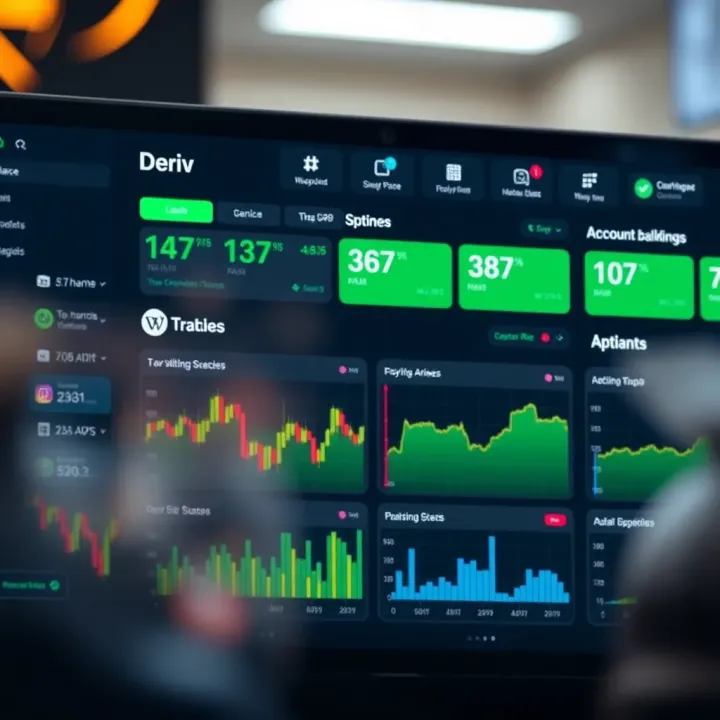
Understanding Deriv Accounts for Kenyan Traders
Learn how to open and manage Deriv accounts in Kenya 🇰🇪. Discover types, verification, funding, and trading tips to boost your success on the platform 📈.
Edited By
Henry Lawson
Trading online has grown quickly in Kenya, and platforms like Deriv.com paired with TradingView provide powerful tools for both new and experienced traders. Using TradingView on Deriv.com allows Kenyan traders to analyse markets effectively, spot trends, and make informed decisions in real time.
Before you dive in, it’s helpful to understand what TradingView brings to the table. It is a widely-used charting platform known for its interactive charts and extensive library of technical indicators. On Deriv.com, TradingView’s features integrate smoothly, giving you a straightforward way to analyse assets, whether you’re trading forex, commodities, or indices.

Getting started involves setting up your Deriv.com account and linking it with TradingView tools. Kenyan traders should ensure their accounts are fully verified to meet regulatory requirements and benefit from smooth transactions. For payments and withdrawals, Deriv supports popular methods in Kenya like M-Pesa, making trading more accessible.
TradingView’s charts are versatile; you can customise timeframes, add indicators like Moving Averages or RSI (Relative Strength Index), and draw trendlines that offer practical insights into price movements. This helps you identify entry and exit points tailored to your trading style.
Here’s why using TradingView on Deriv.com fits Kenyan trading needs:
Local Payment Convenience: Use M-Pesa or bank transfers for deposits and withdrawals.
Detailed Technical Analysis: Access dozens of indicators essential for short-term and long-term strategies.
User-Friendly Interface: Even if you’re new, the charts and tools are easy to navigate.
Effective trading depends on not just tools, but how well you understand and apply them. This guide offers practical steps to make TradingView on Deriv.com work for you in Kenya’s unique trading environment.
From setting up accounts, exploring chart tools, to managing risks, this article covers all you need. You will learn not only what features to use but also how to avoid common mistakes when trading online locally. Mastering these aspects will sharpen your trading edge and help grow your investments more confidently.
Understanding how TradingView works on Deriv.com is key for Kenyan traders aiming to make informed decisions quickly. This section opens the door to practical knowledge of the tools and features that can help in analysing the markets effectively. For instance, knowing how to interpret charts or apply indicators on TradingView directly through Deriv optimises your trading setup and potentially raises your chances of success.
TradingView is a popular web-based platform known for its comprehensive charting capabilities, social network for traders, and real-time data. You get access to various chart types, numerous technical indicators like RSI (Relative Strength Index) and MACD (Moving Average Convergence Divergence), plus tools for drawing trendlines or support and resistance levels. The platform also allows traders to customise views and save templates. This flexibility proves especially useful for Kenyan traders, who often juggle market analysis during short, busy hours.
Deriv.com has integrated TradingView to give its users direct access to these advanced charting features without the hassle of switching platforms. On Deriv, once logged in, you can pull up TradingView charts alongside your trading dashboard, letting you analyse price movements and execute trades seamlessly. For example, you might plot a moving average crossover in TradingView and place a trade immediately on Deriv, cutting down reaction time.
One big plus of using TradingView on Deriv is access to real-time market data and detailed charting tools. Unlike some platforms that show delayed prices, TradingView streams live prices across forex, commodities, indices, and more. This immediacy is crucial, especially during volatile sessions like when the Kenyan shilling fluctuates versus the dollar due to market news. Detailed charts let you spot trends early, plan entry points, and manage your trades proactively.
The user-friendly interface of TradingView on Deriv speaks to both new and seasoned traders. Beginners can start by applying simple indicators or switching between candlestick and line charts to understand price action. At the same time, experienced traders benefit from deep customisation options in indicators and chart layouts. The platform’s clean design makes navigation straightforward, reducing the learning curve and letting you focus on trading rather than fiddling with complicated menus.
Using TradingView on Deriv.com makes your market analysis practical and accessible, bridging powerful tools and effortless trade execution — a combination useful for Kenyan traders keeping pace with dynamic markets.
In summary, understanding the integration of TradingView on Deriv.com equips Kenyan traders with essential tools to analyse, respond, and trade efficiently. The blend of live data, intuitive interface, and charting depth provides a competitive edge in Kenya’s fast-paced trading environment.
Getting started with TradingView on Deriv.com is a necessary first step for Kenyan traders who want to tap into powerful charting and analysis tools without the complexity that often comes with advanced trading platforms. This section walks you through how to set up your account, link it with TradingView, and navigate the interface so you can trade confidently and efficiently.
Before you can enjoy TradingView's features on Deriv, you need a registered account with Deriv.com. The registration process is straightforward: you start by filling out your personal details — name, email, and phone number. It’s practical to use an email and phone number you regularly access since KYC (Know Your Customer) verification documents will be sent there. Kenyan traders should keep their identification documents like a national ID or passport ready for quick verification.
Once registered, linking your Deriv account to TradingView is seamless. Deriv’s integration doesn’t require multiple logins; after signing in to Deriv, TradingView loads inside the platform. This setup saves time and keeps your trading environment unified.
Setting up your login details well is essential to keep your account secure. Choose a strong password combining letters, numbers, and symbols, and enable two-factor authentication (2FA) through apps like Google Authenticator. In Kenya, where mobile phones are indispensable, 2FA adds an extra layer of safety, preventing unauthorised access even if someone gets hold of your password.
The TradingView interface on Deriv presents a user-friendly layout designed to suit both beginners and seasoned traders. On opening, you’ll notice the main chart window flanked by toolbar options for selecting chart types, timeframes, and technical indicators. For instance, switching between candlestick and line charts is just a click away. The platform’s clarity reduces confusion, letting you focus on analysing price movements and planning trades.

Customising charts on TradingView tailored to your trading style helps improve decision-making. You can save chart templates with preferred indicators like the Relative Strength Index (RSI) or Moving Averages to apply quickly. For example, a Kenyan day trader focusing on forex might set 15-minute timeframes with MACD and Bollinger Bands, while a long-term investor tracking NSE shares may prefer daily charts with support and resistance lines.
Customisation keeps your workspace practical and efficient, eliminating the need to reset favourite tools every session.
Overall, understanding how to start and navigate TradingView on Deriv empowers Kenyan traders with reliable tools for smarter trading, all within one platform.
TradingView on Deriv.com offers a wide range of tools that are vital for making informed decisions in today’s dynamic markets. Understanding and using these trading features effectively can give Kenyan traders an edge, whether they are dabbling in forex, indices, or commodities. These tools help break down complex market moves, allowing you to spot trends, predict reversals, and manage trades smartly.
Charts are the backbone of technical trading, and TradingView provides various types to suit different strategies. Candlestick charts are the most popular as they visually represent price movements in a clear way, showing opening, closing, high, and low prices. For example, a bullish candlestick with a long body indicates strong buying pressure – useful when trading currency pairs like USD/KES. Meanwhile, line charts connect closing prices and provide a simplified view, ideal for spotting long-term trends without too much noise. Bar charts offer detailed price info similar to candlesticks but in a different style, often preferred by more traditional traders.
Selecting the right timeframe is equally important. Shorter intervals like 1-minute or 5-minute charts suit intraday traders focusing on quick trades, while longer timeframes such as daily or weekly charts serve well for position traders looking at bigger trends. For instance, a Kenyan trader interested in matatu company stocks might check weekly charts to understand overall direction and daily charts for entry points. Switching between timeframes helps confirm signals and avoids false alarms.
Indicators like Relative Strength Index (RSI), Moving Average Convergence Divergence (MACD), and moving averages are staples. The RSI signals when an asset is overbought or oversold, helping avoid buying high or selling low. MACD shows momentum shifts; for example, a MACD line crossing above the signal line on the NSE 20 index chart may hint at a bullish phase starting. Moving averages smooth out price data and help identify trend direction, such as the 50-day and 200-day moving averages often watched by traders for crossover signals.
Drawing tools on TradingView allow you to mark trendlines and highlight support and resistance zones. These tools are powerful as they visually highlight price levels where markets have bounced before or struggled to break through. Kenyan traders can use this to plot support levels on agricultural stocks during seasonal cycles or resistance levels in currency pairs affected by policy announcements from Central Bank of Kenya. Marking these zones aids clear planning and the setting of stop losses or profit targets.
Mastery of these tools transforms mere price data into actionable insights. It’s not just about seeing the market but understanding the story it tells through these charts and indicators.
By focusing on chart types, timeframes, indicators, and drawing tools offered by TradingView on Deriv, Kenyan traders position themselves to anticipate market moves with confidence and precision.
Practical trading strategies help Kenyan traders make the most of TradingView on Deriv by turning raw data into actionable decisions. Understanding these strategies is key to navigating the markets with confidence, especially when real money is involved. With Deriv’s TradingView integration, traders can combine technical tools and live charts to follow through on tested methods rather than guessing.
Trend-following is one of the simplest and most effective approaches you can start with. The idea is to identify the general direction of an asset’s price—whether it’s moving upwards (bullish) or downwards (bearish)—and trade along that path. For example, if the 50-day moving average on a candlestick chart shows prices climbing steadily, entering a buy position makes practical sense. This helps you avoid fighting the momentum and increases the chance of making profits.
In Kenya’s market environment, where volatility can spike during global events, following trends using TradingView's charting tools on Deriv reduces the chances of small losses from impulsive trades. Beginners can simply watch for consistent higher highs and higher lows in an uptrend or the opposite during downtrends.
Relying on a single indicator can sometimes give false signals. That’s why combining multiple indicators is a smart move. For instance, using the Relative Strength Index (RSI) alongside moving averages helps confirm entries and exits. If the RSI indicates oversold conditions while the price crosses above a moving average, a buy signal becomes stronger.
This dual confirmation prevents jumping into trades prematurely and is especially handy for Kenyan traders who must manage limited capital carefully. TradingView on Deriv allows easy overlay of various indicators so you can spot these aligned signals quickly without switching platforms.
Experienced traders often use price action to read the market’s story directly from candlestick patterns and chart formations rather than relying heavily on indicators. Breakout strategies specifically target moments when price moves decisively beyond a support or resistance level.
For example, a trader might watch a forex pair like USD/KES, waiting for price to break through a resistance level seen on the chart for days. Once confirmed by TradingView tools on Deriv, the trader can enter a buy order expecting the momentum to continue. This can seize opportunities outside normal trading rhythms, especially during economic news releases.
Intraday traders benefit from analysing shorter timeframes such as 5-minute or 15-minute charts to catch small price movements during a single session. Using TradingView on Deriv, one can switch quickly between different periods to spot entry points and manage exits.
For instance, a trader might use a combination of volume spikes and moving average crossovers within a 15-minute chart to identify when a stock listed on the NSE is picking momentum during market open hours. This method helps Kenyan traders time their trades more precisely within the day, which is key for creating steady income from short-term market swings.
Practical strategies on TradingView through Deriv allow Kenyan traders—from novices to pros—to build confidence, limit losses, and spot opportunities faster. Using the right methods tailored to your experience level makes trading not just a chance game but a calculated activity.
These approaches, combined with Deriv’s tools, make technical analysis accessible and actionable for your daily trading needs.
Risk management and trade execution are vital parts of successful trading on Deriv, especially when using TradingView for technical analysis. Without good control over your trading capital and smart trade orders, you risk losing more than you intend. Managing risk carefully improves your chances of steady profits and helps you avoid big financial shocks. Meanwhile, executing trades efficiently through the TradingView-Deriv interface means you can respond quickly as market conditions change.
Setting stop losses and take profit levels is crucial for protecting your money on every trade. A stop loss is a set price where your trade will automatically close to prevent further losses if the market moves against you. On the other hand, a take profit level closes your trade to lock in gains once your target price is reached. For example, if you buy forex for KS00 and decide to limit your loss to KS, your stop loss might be KSh95. Likewise, you could set a take profit level at KS10 if you aim for a 10% gain. This approach avoids emotional decisions and puts clear boundaries on your risk.
Calculating position sizes based on risk tolerance helps you decide how much of your capital to invest in a single trade. It’s wise not to risk more than a small percentage of your total trading funds on any one position. If you have KS0,000 for trading and choose to risk 2% per trade, the maximum loss you accept is KS,000. Using that, you can calculate how many units or contracts to buy to keep losses within that limit. This method ensures no single trade can wipe out your account and supports consistent growth over time.
Placing buy and sell orders directly through TradingView on Deriv simplifies trading execution. Once you analyse markets and spot opportunities, the integration lets you enter orders right from TradingView charts without switching platforms. For instance, spotting a bullish breakout on the 4-hour chart, you can buy the asset with your specified amount and stop loss in a few clicks. This connection saves time and reduces errors that happen when moving between multiple windows or apps.
Monitoring open positions and account balance is equally important for active traders. Deriv’s interface linked with TradingView updates your open trades and account funds in real time. You can quickly see profit or loss on each position and decide if adjustments are needed. For example, if you notice an open trade running close to your stop loss due to sudden market swings, you might choose to close it early or adjust your stop. Keeping track of your overall balance helps avoid overtrading and ensures you always know your available margin.
Sound risk management combined with smooth trade execution is what separates disciplined traders from those who just hope for luck. Kenyan traders benefit by setting clear limits on losses, sticking to calculated position sizes, and taking advantage of TradingView's integration with Deriv to act decisively in the markets.
Navigating the technical side of TradingView on Deriv.com can be tricky, especially for Kenyan traders who may sometimes face unique challenges like spotty internet or unfamiliar platform updates. This section helps you quickly identify common hiccups and fix them, saving you time and frustration. Plus, it offers smart tips tailored to Kenya’s trading environment, such as optimising payment methods and working around local market hours.
Browser compatibility and internet connectivity are among the biggest issues Kenyan traders often face. Some browsers might not support the full functionality of TradingView embedded on Deriv, causing charts to load slowly or tools to malfunction. For instance, Internet Explorer users might spot glitches, while Chrome or Firefox generally give smoother experience. It’s recommended to use updated versions of popular browsers like Chrome or Edge to avoid compatibility snags.
Internet speed also plays a huge role. In many parts of Kenya, network fluctuations are common and can cause charts to freeze or fail to update in real time. A simple fix is to check your network connection before logging in and switch to a wired connection if possible. You might also want to reduce the number of devices sharing the same internet during trading hours to keep your connection stable.
Dealing with platform updates and errors requires a bit of patience. Deriv and TradingView occasionally roll out updates to enhance functionality or security. These updates might cause temporary disruptions or introduce new bugs. For example, you might notice indicator values behaving oddly or order functions slowing down after an update.
To stay ahead, keep an eye on official announcements from Deriv via email or their social media channels. Clearing your browser cache often solves unexpected glitches after an update. Additionally, if you encounter persistent errors, contacting Deriv customer support quickly can help prevent losses and get you back to trading smoothly.
Using M-Pesa and local payment options for deposits and withdrawals improves convenience and trust for Kenyan traders. M-Pesa dominates Kenya’s mobile payments, making it the easiest way to fund your Deriv account or withdraw profits. Linking your M-Pesa number to Deriv ensures instant transactions without the headache of bank delays or currency exchanges. Moreover, some local banks and mobile wallets are now accepted on Deriv, broadening your options.
However, always double-check transaction charges and limits beforehand. For example, small withdrawals below KS,000 may not be economical after fees. Also, confirm that your M-Pesa account details match those registered on Deriv to avoid payment rejection.
Staying updated with Kenyan market hours and regulations is vital to adapt your trading strategy effectively. Markets like NSE (Nairobi Securities Exchange) operate during specific hours—usually 9:00 am to 3:00 pm EAT on weekdays—so syncing your trading on Deriv with local market movements helps you spot better opportunities.
Kenya’s financial regulators sometimes introduce changes that can affect Forex and CFD trading rules. Being aware through CMA (Capital Markets Authority) updates means you avoid inadvertent breaches and penalties. For instance, recent guidelines on leverage limits may impact your risk management on Deriv.
Successful trading isn’t just about charts and strategies, but also smooth technical running and adapting to local realities. Understanding common issues and how to solve them helps you focus on what matters most: making informed trades with confidence.
Learn how to open and manage Deriv accounts in Kenya 🇰🇪. Discover types, verification, funding, and trading tips to boost your success on the platform 📈.
Learn all about Deriv's minimum deposit for Kenyan traders 💰. Get tips on payments, safety, and avoiding deposit errors for smooth trading experience.
Explore Binary.com with our detailed guide for Kenyan traders 📊. Learn platform features, start trading safely, and get tips to boost your experience 🇰🇪.
Explore how Deriv Mpesa connects trading and Mpesa for Kenyan users📱. Learn benefits, security tips🔒, and easy steps for smooth transactions💹.
Based on 10 reviews